We contribute to sustainable development and social responsibility
At Kraft Finans, we want to combine competitive returns with responsible investments. Our classified funds take into account sustainability risk and promote environmental and social attributes where relevant. With these goals and the knowledge we have, we will help to positively impact society and reduce negative impacts.
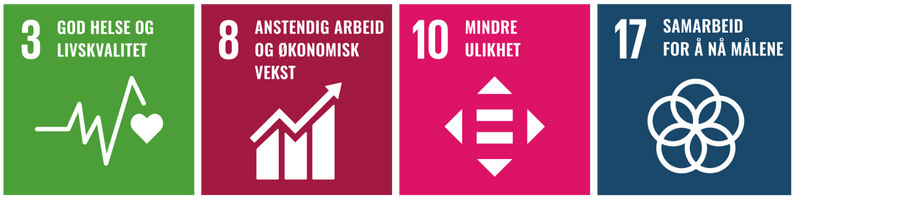
One of the goals we have chosen is good health and quality of life for our employees. We want our employees to have a “good life – balance“. We try to ensure that our employees’ lifestyles are sustainable over time. In this way, we also believe that we can advise our customers in the best possible way, both in a short-term and long-term perspective. These measures are done by offering employees training at local fitness centers. Joint training sessions together, and padel offers .
In addition, employees have health and medical insurance.
Kraft Finans wants to promote lasting, inclusive and sustainable growth for everyone. To achieve this goal, we must have good rules that safeguard employees’ rights, and someone who dares to speak up when the rules are broken. We are committed to protecting employee rights and focus on avoiding discrimination and unequal treatment.
Kraft Finans has good routines for how to report censurable conditions in the employer’s business.
Despite the fact that Norway is a prosperous country with a well-functioning welfare state, there are significant differences between rich and poor. In order to achieve sustainable development, measures must be taken to reduce inequalities.
By offering tailored personal advice, both in the private market and the corporate market, we can help people make good financial choices and avoid ending up in a difficult financial position.
To succeed in sustainable development, we need to collaborate across sectors and interests. Governments, businesses, the financial sector and civil society all have an important role to play in achieving the UN Sustainable Development Goals. In Norway, there is a strong foundation for cooperation through an open business community, high levels of trust and common goals for green transition. Kraft Finans is an active driver for collaboration and knowledge sharing in the financial industry.
The purpose of this policy is to describe Kraft Finans’ approach to sustainable investments, including how environmental, social and governance (ESG) issues are integrated into the business. Kraft Finans believes that good work leads to higher, long-term and risk-adjusted returns for investors by reducing unwanted risk factors and identifying profitable opportunities. The company offers its own funds that are classified under SFDR Article 6 and Article 8, and undertakes to comply fully with the regulations. The company also offers several funds through its partner Nordnet.
This policy applies to all activities where Kraft Finans provides investment advice, management or distribution of funds. It covers:
– integration of sustainability risks in investment and advisory processes,
– Product specific requirements for funds under SFDR art. 6 and 8,
– transparency and disclosure of sustainability information.
– Sustainability risks: Events or conditions of an environmental, social or governance nature that may have an actual or potential negative impact on the value of investments and/or the performance of funds
– Sustainability factors: ESG issues relevant to investment decisions and risk assessments.
The CEO is ultimately responsible for the implementation of and compliance with the policy. The Board of Directors approves and revises the policy at least annually.
The investment director and fund managers are responsible for ensuring that the policy is integrated into analyses, decisions and the exercise of ownership. The policy is made known to all employees and published on the company’s website.
The company identifies, assesses and monitors sustainability risks in all investment decisions where sustainability is considered relevant. This includes:
– ongoing assessment of sustainability factors related to the investment objects
– management of identified risks through exclusion or active ownership (both dialogue and voting at general meetings).
Kraft Finans does not invest in companies that:
– contribute to violations of human rights or international law,
– produces controversial weapons (nuclear, chemical, biological, cluster munitions, landmines),
– is responsible for serious climate and environmental degradation,
– are involved in systematic corruption,
– are on the Government Pension Fund Global (GPFG) exclusion list
List of excluded companies can be made available to investors upon request.
The company seeks to influence companies through dialog and voting wherever possible, with the aim of improving the handling of significant sustainability factors.
Kraft Finans only invests in companies that follow principles of good corporate governance, including responsible management, anti-corruption, transparency, etc.
Employees who work with investments, advisory services or product development receive regular training in sustainability and SFDR regulations, including via external professional gatherings, courses and seminars.
Kraft Finans offers funds that report according to SFDR articles 6 and 8. The following principles apply to the reporting
The company publishes relevant information about its sustainability work on its website and in reports, including:
Kraft Finans is committed to continuous monitoring of regulatory changes, evaluation of internal processes and updating of the policy.
The policy is reviewed at least once a year and approved by the Board.
At Kraft Finans as, we want to offer investments that can both provide competitive returns and at the same time contribute to a more sustainable development. We manage our own funds classified under SFDR articles 6 and 8, and also offer a wide range of alternative investments and UCITS/Model portfolios/ETFs. We customize our customers’ preferences by obtaining customers’ sustainability preferences in the suitability assessment of customers. Some customers have clear sustainability preferences, while others less so. Through personal advice, we can then uncover and make transparent assessments so that the customer can make investment choices that are in line with their own goals.
We comply with EU regulations Sustainable Finance Disclosure Regulation (SFDR) and adapt our processes in line with applicable transparency and reporting and reporting requirements.
Takes sustainability risksinto account as part of investment decisions, but does not promote environmental or social attributes and does not have sustainability as a primary objective.
Promotes environmental and/or social attributes. Uses exclusion criteria and positive selection, and places particular emphasis on climate, renewable energy and good corporate governance.
More information under Priips key information.
Through collaboration with Nordnet, we offer a wide range of equity funds. Classification and sustainability information for these funds follows the information provided by the respective managers.
Kraft Finans also offers alternative investments where Kraft Finans Corporate department is the facilitator. In these areas, access to sustainability datavaries , but we assess sustainability risks where relevant and adapt continuously in line with increased reporting requirements .
Sustainability for an investment firm involves integrating environmental, social and governance (ESG) considerations into all investment and advisory processes, in line with regulatory requirements (EU taxonomy, SFDR, MiFID II), to promote long-term value creation, mitigate sustainability risks and support the transition to a more sustainable economy.
Investment advisors shall map their clients’ sustainability preferences and offer products in line with these.
Sustainability is integrated into suitability assessments and advisory process.
Requires companies to report in standardized sustainability information according to ESRS.
Provides the information basis that investment firms use in their analysis and advice.
A classification system that defines what can be considered environmentally sustainable economic activities.
Used to assess whether investments qualify as “green”; investment “green”; investment firms must understand and report accordingly. this.
Requires financial institutions to disclose about how sustainability risks integrated into investment decisions and advice.
Investment firms must disclose ESG policies, product classification (art. 6/8/9) and sustainability indicators.
Investments with measurable positive environmental or social impact in addition to financial returns.
Product development and customer profiling.
Active ownership to influence companies towards sustainable practices.
Dialogue, voting, reporting.
Systematic incorporation of environmental, social and governance factors in analysis and decisions.
Analysts and portfolio managers.
An investment in an economic activity activity that contributes to an environmental or social goal, without significant harm to other objectives, and with good corporate governance.
Used for product classification (art. 8/9 funds) and consulting.
An environmental, social or governance-related event that may affect the value of the investment negatively.
Risk analysis and compliance.
According to the EU Sustainable Finance Disclosure Regulation (SFDR) Article 4, financial market participants must disclose whether they take into account the so-called Principal Adverse Impacts(PAI) of investment decisions on sustainability factors .
As of today, Kraft Finans has chosen not to take PAI into account in its investment decisions. The reason is that we consider that the availability and quality of data for the mandatory and voluntary PAI indicators set out in the SFDR (Annex I) is not sufficient to conduct a a consistent and reliable assessment. Our funds that are Article 6 ointegrate sustainability risks as part of the overall risk assessment, but risk assessment, but do not promote environmental or social characteristics and do not have sustainable investments as a purpose. These funds funds are therefore not covered by PAI reporting. Our Article 8 funds take into account sustainability risks and promote environmental and/or social characteristics, but the funds have not yet implemented adequate and comprehensive reporting which makes it challenging to take PAI into account..
We follow the development of methodology and standards for PAI reporting, but have currently not included PAI in our investment process or reporting due to insufficient data. Due to fragmented data, it is difficult to assess a comprehensive picture of the full range of negative impacts that an investment may have on the environment, society or companies. Kraft Finans recognizes that assessing PAI is a key element of sustainable finance. We therefore follow developments within: Data availability and standardization from portfolio companies and data providers. Regulatory requirements from the EU and Norwegian authorities. Industry practices evolving in line with the implementation of SFDR and the EU taxonomy.
We will continuously consider including PAI considerations in our investment processes and public reporting when we assess that the data quality and methods are sufficient to provide a fair presentation. The aim is to ensure that investment advice is provided at a satisfactory level.
We recognize that sustainable finance is rapidly evolving and our long-term goals are to increase the level of transparency and reporting in our funds and to progressively strengthen the integration of PAI in line with improved data access. Actively contribute to a responsible finance industry in collaboration with customers, managers and partners.
Kraft Finans AS is a Norwegian investment firm that offers wealth management services to individuals, companies and foundations.

Would you like more information about our services for you or your company?
Feel free to contact us in a way that suits you.


